
Fliteboard, Lift, Waydoo or Awake: which brand?
Which board suits your weight? What will you notice about assembly, noise and controls? Compare the current Fliteboard, Lift, Waydoo and Awake ranges using manufacturer data and riders' experiences.
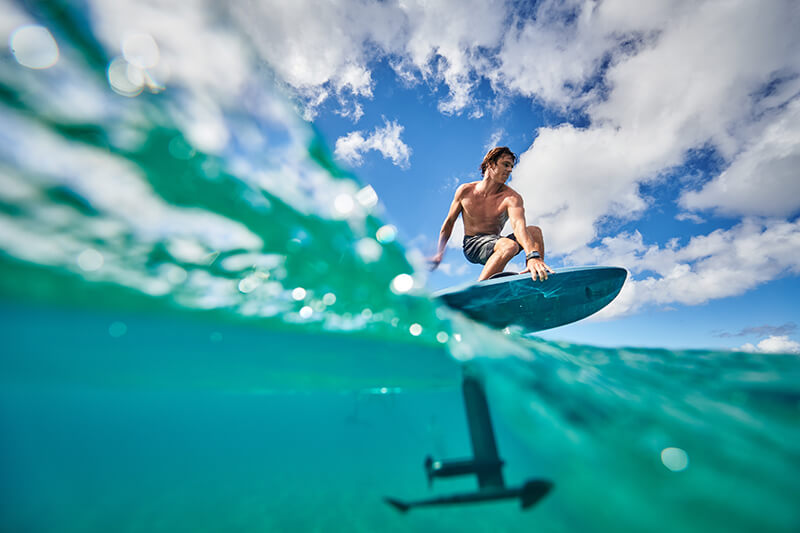
Lift makes LIFT5 assembly straightforward with quick connections. Fliteboard offers a wide choice of boards and propulsion, with clear differences between generations. Waydoo combines EPP boards with modular assembly and riding assistance on its Plus models. Sweden’s Awake uses jet propulsion and quick connections on VINGA. Your choice also depends on what you have to carry, assemble and clean every session.
Start with your weight and experience. Then choose the wing, the underwater lifting surface, and the battery. A small board with a large wing rides differently from a large board with a small wing. Once flying, you feel the whole combination.
This overview follows the current ranges on the brands’ own websites, checked on 13 November 2026. We have not tested these boards side by side. Figures are manufacturer specifications. Testers’ and riders’ experiences are identified as such. A catalogue listing does not confirm stock in the Netherlands.
Flitescooter and similar boards with handlebars sit outside this comparison, while the Blowfish is a useful separate learning aid around a conventional Lift board.
Which efoil board suits your weight?
This table is our starting point for your first setup after a few lessons. The model tables below also include smaller boards for experienced riders. Weight narrows your options, while technique and riding conditions determine how much board you prefer.
For Awake, this table covers the VINGA Carve. The product page we read does not list a rider weight. We therefore give no weight recommendation for this model. The RÄVIK jetboards are listed separately below.
| Your weight | Fliteboard | Lift | Waydoo | Awake, VINGA Carve |
|---|---|---|---|---|
| Up to 70 kg | ICON or AIR ICON for a forgiving start. PRO or AIR PRO if you can already stand up confidently. | LIFT5 F Sport or LIFT5 Sport. Cruiser if you want more stability. | EVO Lite or Pro Plus. Max Plus for sharing or extra volume. | Suitability for your weight not confirmed. Have the complete setup matched to you. |
| Over 70 to 85 kg | ICON or AIR ICON. PRO becomes more relevant once you start easily. | Sport for a compact setup, Cruiser for more support during takeoff. | Pro Plus as the middle size. Max Plus for more stability. Lite is still within the brand’s recommendation. | Suitability for your weight not confirmed. Have the complete setup matched to you. |
| Over 85 to 100 kg | ICON. Propulsion matters too, see the brand’s recommendations below. | LIFT5 F Cruiser or LIFT5 Cruiser. Sport is listed up to 100 kg but offers less support when standing up. | Max Plus as a starting point. Pro Plus if standing up is already easier. Waydoo recommends Lite up to 90 kg. | Suitability for your weight not confirmed. Have your ability to stand up assessed too. |
| Over 100 to 113 kg | ICON with Flite Prop is within the weight recommendation. Jet 2 puts you above its recommended 100 kg. | Cruiser, carbon or fibreglass, is listed up to 113 kg. | Max Plus for learning. Pro Plus has the same weight recommendation but less board volume. | No confirmed weight recommendation for this band. Ask Awake to confirm. |
| Over 113 to 120 kg | ICON with Flite Prop. You are approaching its 120 kg limit. | No conventional board within the published figures without added flotation. | Max Plus, within Waydoo’s recommendation up to 130 kg. | No confirmed weight recommendation for this band. Ask Awake to confirm. |
| Over 120 to 130 kg | Outside the published limits of the boards listed here. | Outside the published figures without added flotation. | Max Plus is within the brand’s recommendation. Have the complete setup matched to your weight. | No confirmed weight recommendation for this band. Ask Awake to confirm. |
A weight recommendation does not promise an easy start. Waydoo illustrates this: both the 90-litre Pro Plus and the 130-litre Max Plus are recommended up to 130 kg. The larger board gives you more platform before takeoff. Above 130 kg, we could not confirm a suitable manufacturer figure within these four conventional board ranges.
Fliteboard: from AIR ICON to ULTRA L3
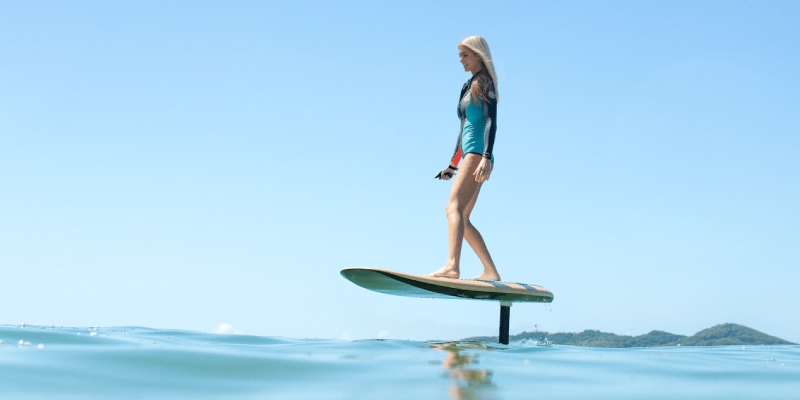
ICON and PRO come in Carbon, Fibreglass and Soft Top 2. These are different constructions of the same board size. AIR has an inflatable outer section, but you ride it with a conventional handheld controller.
| Board or version | Volume | Published rider weight | Why choose it? |
|---|---|---|---|
| AIR ICON | 110 litres | Recommended up to 120 kg with Prop, 100 kg with Jet 2. Limit 120 kg. | A large platform with an inflatable outer section. |
| ICON Carbon, Fibreglass, Soft Top 2 | 100 litres | Recommended up to 120 kg with Prop, 100 kg with Jet 2. Limit 120 kg. | A conventional all-round board, including for heavier beginners. |
| AIR PRO | 80 litres | Recommended up to 100 kg. Limit 120 kg. | A smaller inflatable board for riders who start more easily. |
| PRO Carbon, Fibreglass, Soft Top 2 | 67 litres | Recommended up to 100 kg. Limit 120 kg. | More compact riding and active turns. |
| MN86 | 86 litres | Recommended up to 120 kg with Prop, 100 kg with Jet 2. Limit 120 kg. | A carbon board from the Marc Newson range. |
| MN60 | 60 litres | Recommended up to 100 kg. Board limit 120 kg. | A smaller board from the same range. |
| MN60 Wave | 60 litres | MN60 board limit: 120 kg. No separate weight recommendation confirmed for Wave propulsion. | Experienced riders who also want to ride waves without motor power. |
| RACE x Mercury Racing | 58 litres | Limit 100 kg. | Fast riding on a narrow board. |
| ULTRA L3 | 49 litres | Limit 100 kg. | Experienced riders seeking less board underfoot and wave riding. |
| Flite AIR x Axopar | Not confirmed on the brand page read | Not separately confirmed | A boat-oriented version with added protection and storage features. |
Sources: model range, sizes and limits, weight recommendations by propulsion, Marc Newson and Axopar.
The distinction between recommendation and limit matters. Fliteboard lists 120 kg on the PRO page but recommends a maximum of 100 kg in its weight table. That higher limit does not make PRO an obvious beginner board for a 115 kg rider. We also do not automatically apply older ULTRA recommendations to the L3.
Lift: LIFT5 F, LIFT5 and LIFTX
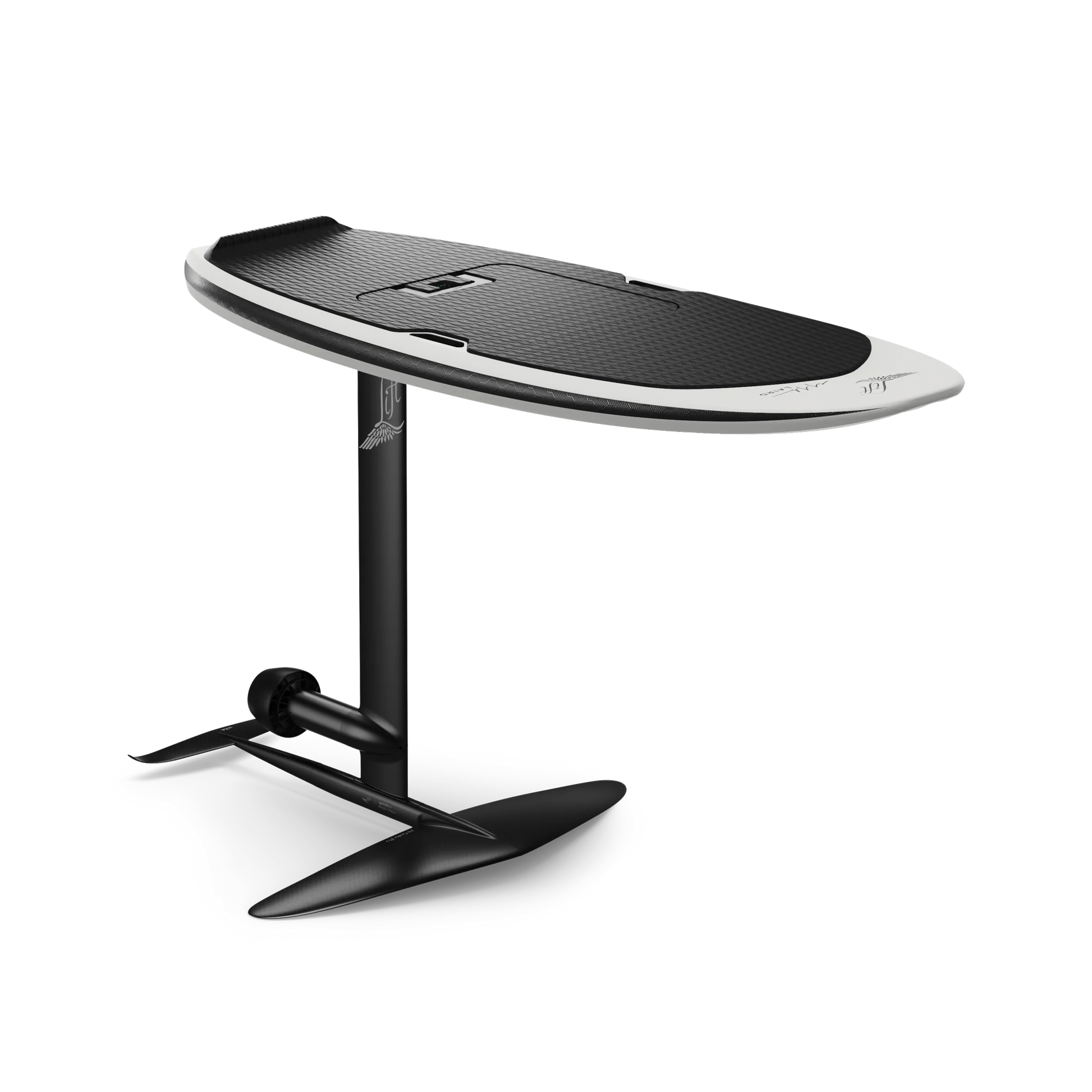
LIFT5 F has a fibreglass board and an aluminium mast as standard. LIFT5 has a carbon board and carbon propulsion. LIFTX pairs smaller boards with a lighter battery and propulsion designed for riding with and without motor power.
| Board | Volume | Stated maximum rider weight without Blowfish | Why choose it? |
|---|---|---|---|
| LIFT5 F Sport 4’9 | 67 litres | 100 kg | A compact fibreglass board with room to progress. |
| LIFT5 F Cruiser 5’4 | 83 litres | 113 kg | More support at takeoff, larger riders and shared use. |
| LIFT5 Pro 4’4 | 55 litres | 86 kg | Experienced or light riders wanting a short board. |
| LIFT5 Sport 4’9 | 67 litres | 100 kg | The all-round carbon size. |
| LIFT5 Cruiser 5’4 | 83 litres | 113 kg | The largest conventional LIFT5 board. |
| LIFT5 Laird 5’2 | 64 litres | 100 kg | A narrower special edition. The new collection page listed it as out of stock. |
| LIFTX 4’3 | 42 litres | 79 kg | The small version for experienced riders. |
| LIFTX Florence 4’7 | 49 litres | 82 kg | A special edition for active turns and wave riding. |
| LIFTX 4’8 | 52 litres | 84 kg | The middle size for experienced riders. |
| LIFTX 5’2 | 64 litres | 91 kg | More platform within the LIFTX range. |
| LIFTX 5’4 | 70 litres | 100 kg | The largest LIFTX, including for larger riders within that range. |
Sources: LIFT5, LIFT5 F, LIFTX, Florence specifications and new collection.
Lift’s size guide describes weight recommendations as guidance for flotation and takeoff. Experience still matters. For volumes, we follow the current product tables. Some Lift blog posts give different volumes for the same size.
A 70-litre LIFTX 5’4 is still a different starting platform from an 83-litre Cruiser. Choose LIFTX for its lighter setup and riding without motor power. Simply fitting inside the weight table is a weak reason to choose it.
Waydoo: four EVO versions
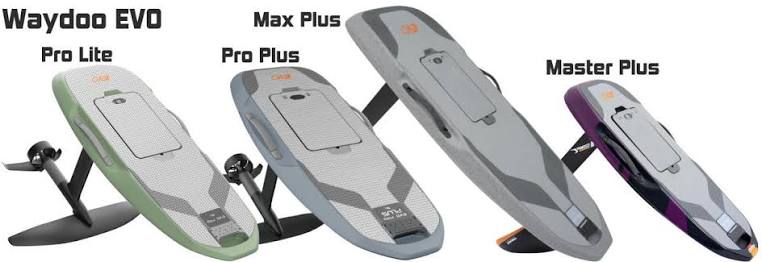
Lite and Pro Plus have the same nominal board volume but differ in motor power and sensors. Plus models have Flight Assist. The Pro Plus name therefore does not mean a smaller board than Lite.
| Version | Board | Manufacturer’s weight recommendation | Why choose it? |
|---|---|---|---|
| EVO Lite | 90 litres, EPP | Up to 90 kg | 4 kW propulsion, without Flight Assist. |
| EVO Pro Plus | 90 litres, EPP | Up to 130 kg | 6 kW and Flight Assist on the middle size. |
| EVO Max Plus | 130 litres, EPP | Up to 130 kg | The largest platform, for learning, sharing and heavier riders. |
| EVO Master Plus | 75 litres, Kevlar | Up to 100 kg | A carbon mast and a smaller setup for experienced riders. |
Sources: official EVO brochure through the download centre, Lite, Pro Plus, Max Plus and Master Plus.
Dealers may still carry older generations such as LIFT4, Flyer One and earlier Fliteboard series. They sit outside this overview of the current brand ranges. Their connections, noise and maintenance can differ.
Awake: VINGA Carve
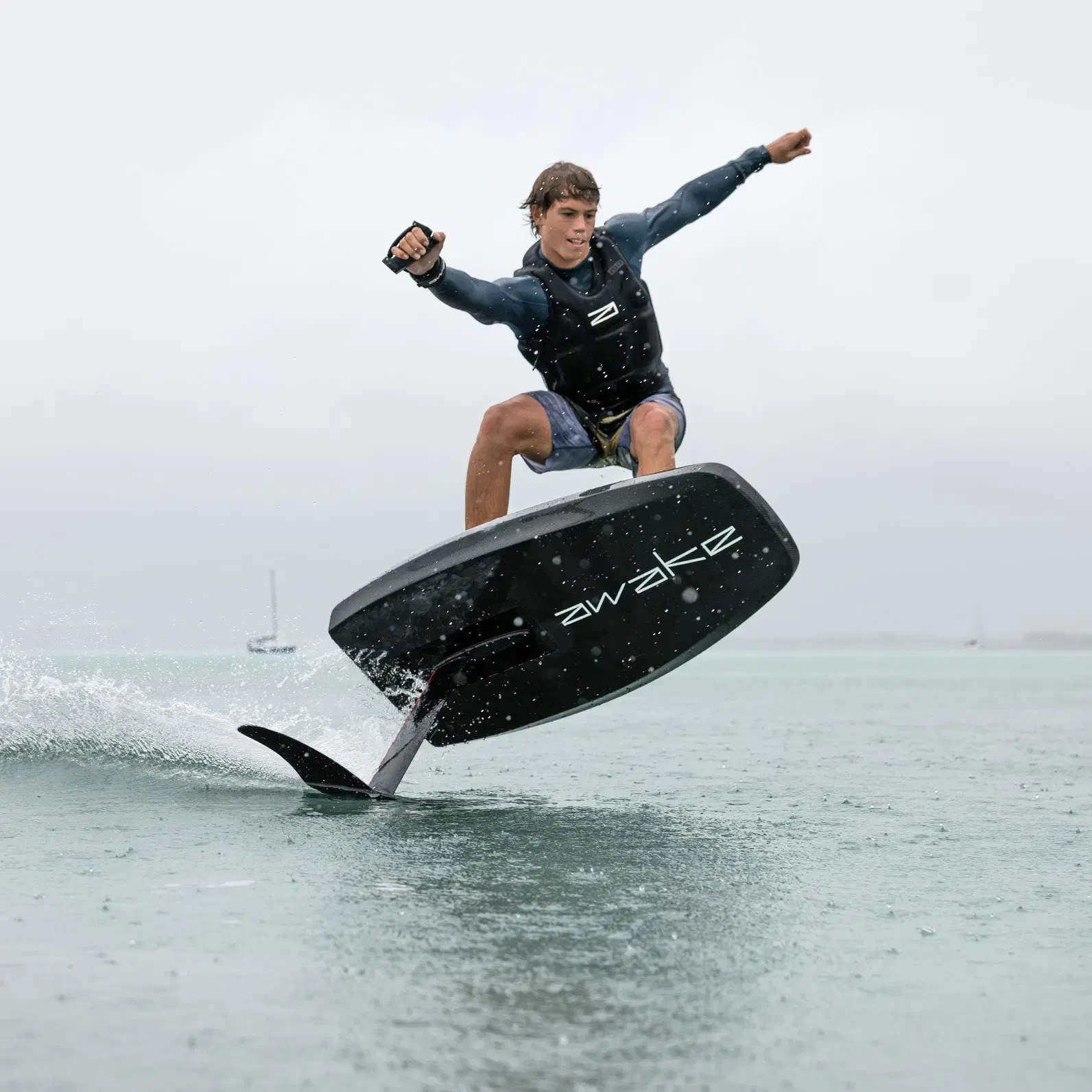
The VINGA Carve is Awake’s efoil board: 77 litres, with an 80 cm mast and Cloud Wings. Awake lists no rider weight on the product page. Factor in your weight and experience during a test ride.
The older VINGA 3 and S remain in the help centre with 95 and 60 litres and a 110 kg rider weight. They are no longer in the shop, so those figures do not automatically apply to the Carve. Awake also sells RÄVIK jetboards, which ride on the surface without a hydrofoil. That is a different sport.
The Brabus x Awake Shadow Carve is a limited edition for experienced riders, not a beginner board.
Assembly: what do you do every session?
Lift: quick connections make a practical difference
On LIFT5 and LIFTX, a lever secures the mast. The battery drops into its recess and locks with its handle. You do not attach loose battery cables. An LCS front wing clicks onto the mast. The back wing bolts to the front wing and can stay attached to it.
That last detail matters: quick assembly does not mean every Lift component is screw-free. LIFT5 F’s standard wings are bolt-on versions. Their routine differs from the LCS wings on LIFT5.
In The Foiling Magazine’s hands-on review, assembly stood out. The testers found the quick connections and battery bag useful. They rode at Lift’s invitation in Puerto Rico. This was experience during a product introduction, not a long-term reliability test. LIFT5 owners on Reddit also highlight assembly and pack-down.
Fliteboard: attach the mast, close the battery compartment
Fliteboard retains a battery compartment with a lid and separate power connections. You attach the mast to the board and fit the wings according to the chosen system. Sand around the seal and connections needs attention. AIR also needs inflation if you transport it deflated.
First use also involves activation and updates through the Flite App, as described in the Quickstart. Daily assembly and initial installation are different routines.
Waydoo: more separate modules
On EVO, the mast and motor unit are separate components. You assemble them, fit the wings and secure the battery with rotary locks. That allows replacement by module but also creates connections to inspect and keep clean.
A timed demonstration by eFoil Miami finished in under four minutes. The provider sells Waydoo. The battery was already inside the board and the equipment was prepared. Comparing that figure with a completely packed Lift would be misleading.
Awake: click the board and battery into place
On VINGA, Click-to-Ride connects the board to the mast unit. You secure the battery with its handle. Its lid becomes part of the deck, without separate battery cables or a hatch.
That does not make every wing connection screw-free. Awake’s assembly guide for the older VINGA 3 and S shows bolts for Powder and Fluid wings. Check how your own wing set attaches. On the VINGA 3, Boat & Sail found separate transport and quick connections particularly useful. That is a test experience with that generation, not a measured assembly time for the Carve.
Noise: propulsion matters more than the logo
Riders describe older Fliteboard propulsion as higher-pitched and sharper than Lift. An AIR PRO owner in 2024 found a friend’s Lift 4 quieter but preferred the way their Fliteboard rode. Those are separate preferences.
Do not apply that experience to every new Fliteboard. The Foiling Magazine tested a PRO with Flite Jet 2, an 80 cm aluminium mast, Nano and Wave 850 C. Its testers heard much less propulsion noise than on earlier generations and found acceleration and takeoff smoother. They rode on flat water.
After two days testing LIFT5, Boat & Sail also described quieter propulsion than on previous Lift models. The test took place at the brand’s premises and the publication discloses affiliate income. Waydoo riders also describe EVO with its standard propeller as quiet, for example in this August 2026 discussion.
On the older VINGA 3, Boat & Sail described the jet as quiet and smooth during acceleration. Its team rode the board on two occasions and discloses affiliate income. That is a riding impression, not a decibel measurement of the current Carve or the RÄVIK jetboards.
Comparable noise measurements covering all four are missing, so we do not name a quietest brand. A camera beside the mast and one on a helmet also capture different sounds.
Controls: quick response and smooth adjustment
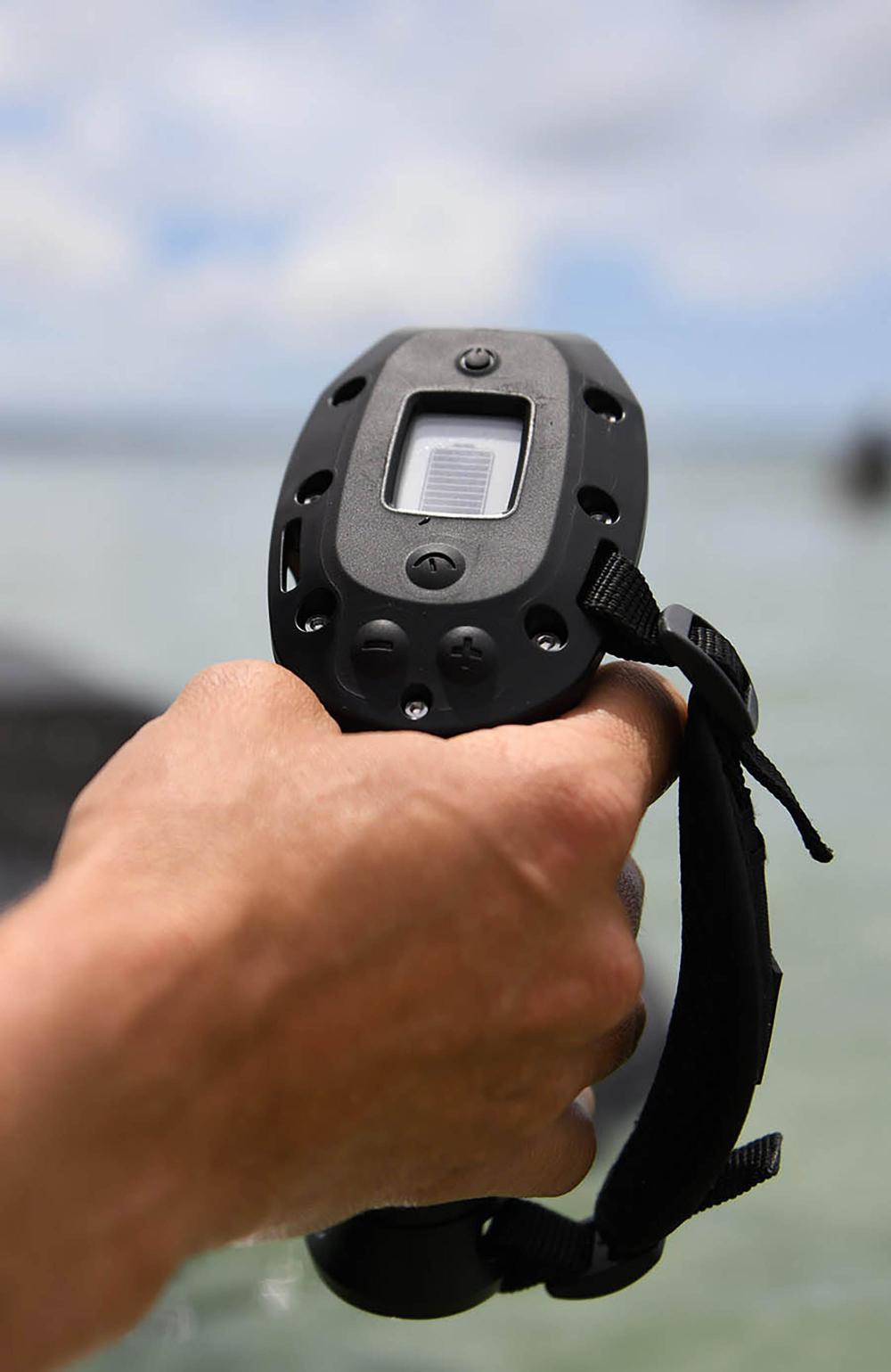
You want to make small corrections without sudden acceleration. Trigger travel, power settings and software all matter.
The Foiling Magazine found its LIFT5’s power delivery linear and easy to adjust. In a Reddit discussion about throttle response, riders describe the EVO remote’s longer trigger travel as an improvement over older Waydoos. Other contributors like Fliteboard’s immediate response or the Lift Elite controller. These are experiences with different setups, not measured delays in milliseconds.
Restarting after a fall feels different too. In a comparison of older Lift and Fliteboard models, a rider likes Lift’s trigger but finds unlocking Fliteboard again cumbersome. Another rider may appreciate that safety step. The discussion is not a full comparison of today’s controllers.
Waydoo’s Flight Assist adjusts motor power. On FOIL.zone, a test rider describes hearing and feeling those corrections. On r/eFoil, users find the assistance subtler than expected. A large weight shift can override the correction. The manual recommends the function for calm water. You still steer and balance yourself.
Awake supplies the Carve with the Flex Hand Controller 4. According to the manufacturer, it has a 2.4-inch colour screen, customisable display views and SmartPair to connect to the battery. The promised fine throttle control is a manufacturer claim. On the older VINGA 3, Boat & Sail needed time to get used to the thumb throttle and then found speed easy to adjust. That experience is not a test of controller 4.
What feels premium?
With Lift, testers mention the finish of the bags, the flush-fitting battery and the quick connections. Fliteboard’s tangible differences include board construction, controls and aluminium or carbon propulsion. Soft Top 2 adds a protective outer skin around a fibreglass core. The Marc Newson range has a carbon construction joining mast, fuselage and tail in one structure.
Waydoo’s EPP exterior looks and feels different from exposed carbon. That alone says little about turning performance or electronics lifespan. Master Plus uses Kevlar and a carbon mast instead. A judgement about one Waydoo version does not automatically apply to the whole range.
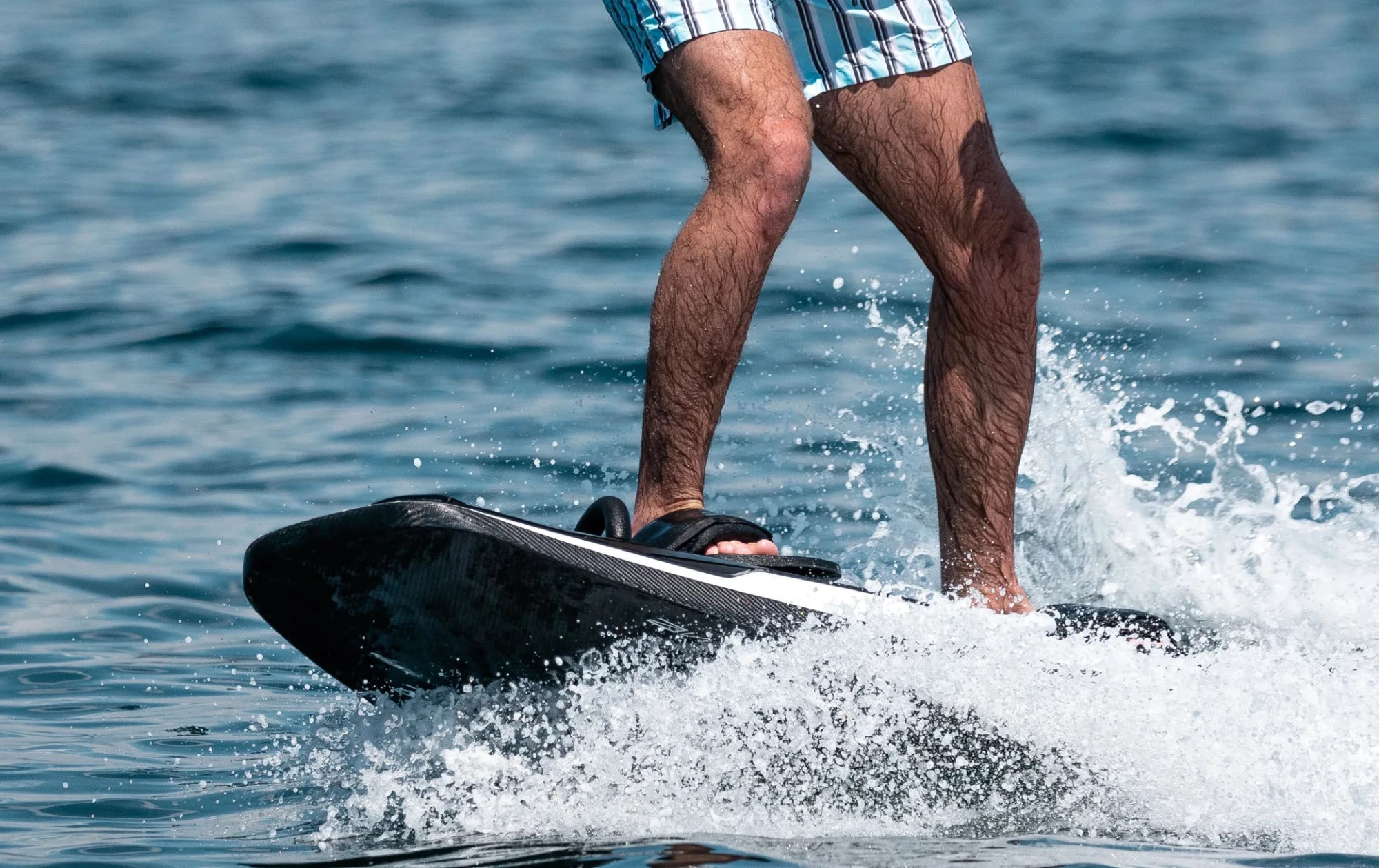
Awake’s tangible differences include the quick connections, a battery that becomes part of the deck and controller 4’s colour screen.
The useful difference is in what you handle: carrying grips, locks, the trigger and the bags. An expensive carbon setup can ride well and still be awkward on your stairs to the water.
Component weights: what do you actually lift?
These examples are manufacturer figures, not our measurements. A mast including its motor differs from a mast alone. The setups also have different battery capacities and purposes.
| Component | Fliteboard examples | Lift, LIFT5 Sport 4’9 | Waydoo, EVO Pro Plus |
|---|---|---|---|
| Board without removable battery | ULTRA L3: 6 kg. This is a small performance board. | 9.5 kg | 10.6 kg |
| Battery | Ti Nano 6.2 kg, Ti Sport 10.6 kg, Ti Explore 14.5 kg | Gen5 Full Range: 13.8 kg | Powerflight 18: 15.7 kg, Powerflight 23: 17.5 kg |
| Mast and propulsion | MN Wave 82 cm: 4.9 kg. Jet 2 Aluminium 80 cm: 7.5 kg. | Stated propulsion weight: 4.99 kg | Aluminium mast alone: 3.6 kg at 69 cm or 4.1 kg at 89 cm. Add the motor unit. |
| Wing | No separate weight confirmed for the selected current wing set | Stated wing weight for the standard setup: 2.27 kg | Glider C1500 front wing: 1.5 kg. Back wing and motor unit are additional. |
Sources: Fliteboard support, LIFT5 Sport specifications and the Waydoo brochure.
Waydoo’s battery is the heaviest separate component in these examples. With Fliteboard, the choice between Ti Nano and Ti Explore alone changes the weight by 8.3 kg. Explore does not fit AIR ICON or AIR PRO. Lift lists a complete LIFT5 Sport at about 30.6 kg and a complete LIFTX 4’8 at about 20.5 kg. LIFTX also has a smaller battery and a different purpose.
Awake’s current Carve components are listed separately below. These are also manufacturer figures.
| Component | Awake, VINGA Carve |
|---|---|
| Board without removable battery | Stated board weight: 7.5 kg |
| Battery | Flex LR 4: 12 kg. Flex XR 4: 18.5 kg. |
| Mast and propulsion | Stated drivetrain weight: 8.5 kg. No separate mast measurement. |
| Wing | Cloud Wings as standard. No separate weight confirmed. |
The XR 4 therefore weighs more than the Waydoo batteries listed above. Within Awake, choosing LR 4 rather than XR 4 saves 6.5 kg according to the manufacturer. The Carve board’s 7.5 kg is not the weight of a complete setup ready to ride. We do not add the components into a total because it is unclear whether the stated drivetrain weight includes the wings.
Daily use therefore involves more than the lowest advertised total weight. Can you carry the battery separately, where are the handles, and how many bags do you need?
Lifespan and maintenance
For none of the four brands did we find comparable data supporting a lifespan in years or a failure rate. There are useful maintenance differences.
Fliteboard requires Jet C with Flite Jet 2 to be serviced after two years or 200 hours, whichever comes first. Prop C, older Dual Drive systems and MN Wave require service after one year or 100 hours. An authorised service partner must perform this work. The official service schedule is more useful than a general promise of low maintenance.
In its LIFT5/LIFTX manual, Lift also requires attention to quick-release mechanisms, contacts and cooling passages after use. Fast assembly still leaves rinsing, drying and inspection to do.
Waydoo’s manual describes checks of the mast-to-motor connection, seals, battery locks and cooling. The EPP board can show wear without needing the same repair as a hard outer shell. eFoil Miami shows an EVO lesson board after almost two years, including dents and a crack. The provider says it still rides well. That is one board documented by a seller, not proof of every EVO’s lifespan.
Awake’s maintenance guidance requires rinsing the components separately with fresh water after every ride and letting them dry completely. Use no pressure washer. Check connections and loose bolts and remove debris from the jet. The published VINGA manuals still cover older generations. For the Carve with Flex 4, ask for the matching battery storage and maintenance instructions. We have not confirmed a fixed service interval or substantiated lifespan for this model.
Follow your own generation’s manual for cleaning and lubrication. A product or routine intended for one connection does not automatically suit another brand.
Parts: check the generation
When you buy separate parts, check the generation. A Gen5 battery does not fit LIFT4. Within LIFT5, there are also options using a LIFTX battery and an adapter. With Fliteboard, battery compartment and wing interface matter. With Waydoo, the separate module must suit the EVO combination. Keep the exact component list with your purchase receipt.
That generation check also matters with Awake: according to the brand, controller 4 works with LR 4 and XR 4, but not the older SR and XR batteries. A shared Flex logo therefore does not make every controller compatible with every battery generation.
Sources
Model data and manuals were checked on 13 November 2026. Links beside the tables lead to the manufacturers. These sources inform the account of use on the water:
- The Foiling Magazine: LIFT5 and LIFTX, hands-on review at Lift’s invitation.
- The Foiling Magazine: Flite Jet 2, testing a specified PRO setup on flat water.
- Boat & Sail: LIFT5, two test days at Lift, with affiliate disclosure.
- Reddit: throttle response, experiences across generations.
- Reddit: AIR PRO noise and propulsion noise in 2026, personal observations.
- FOIL.zone: EVO Flight Assist and Reddit: what does the assistance do?, riding experiences alongside the manufacturer’s description.
- Waydoo: manual and brochure, assembly, maintenance and technical data.
- Awake: current shop and VINGA Carve, current efoil range, volume and component weights.
- Awake: RÄVIK specifications, rider weight, absolute limit and construction. VINGA specifications from 2024 cover 3 and S, not automatically Carve.
- Awake: Click-to-Ride and VINGA assembly guide, locks and the older Powder and Fluid wing connections.
- Awake: Flex LR 4, Flex XR 4 and Flex Hand Controller 4, manufacturer weights, controls and compatibility.
- Awake: after the ride, VINGA manuals and support contact, maintenance and the route to support.
- Boat & Sail: VINGA 3, a few hours riding on two occasions, with affiliate disclosure. Used for assembly, noise and thumb throttle experiences with that older generation.
For more on the components, read Choosing your first eFoil. For a lesson or guided introduction, see where to try efoiling.