
eFoiling abroad: what's allowed where?
Dutch water is cooling down and the thick wetsuits are coming out. If you don't fancy a winter break, you look at southern Europe, or plan a trip for next year. But bring your own board and you drive through a patchwork of rules.
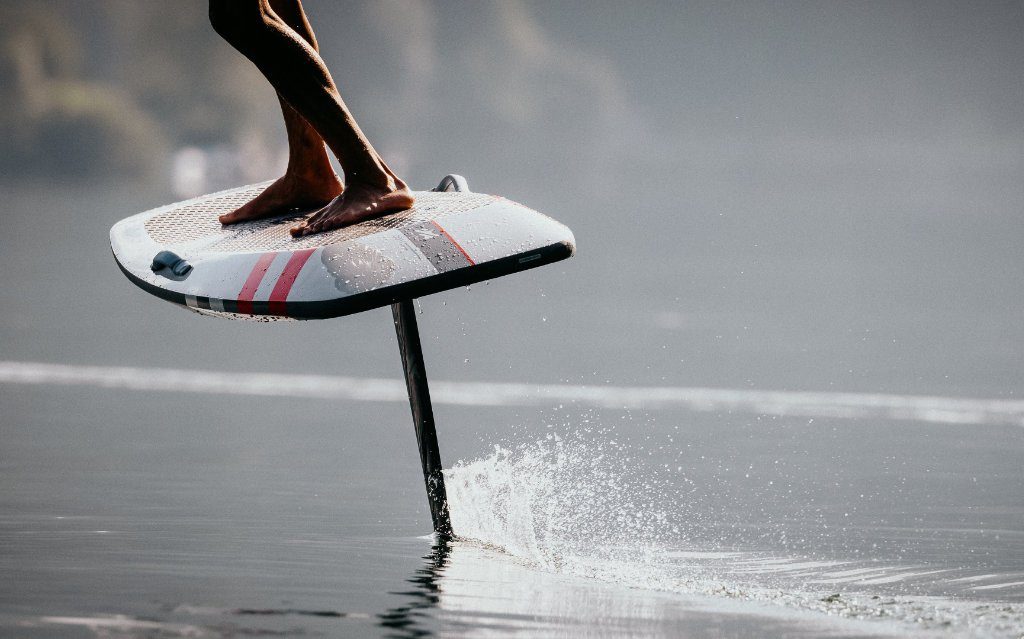
E-Surfer listed every European country. Good news if you ride in the Netherlands: it comes out as the strictest country. With a Dutch boating licence and RDW registration, things are usually easier elsewhere. But there are a few countries where your board is better left in the car.
Driving through Switzerland or Austria? Leave the board in the car
In Switzerland, eFoiling on public water is effectively banned. Small motorised boards can’t be registered there. In 2022 the federal court upheld a fine for someone who eFoiled on Lake Geneva. Legalisation is being looked at, but as of mid-2026 nothing had changed.
Austria has no national rule, but most lakes ban eFoils. And it’s enforced: on the Traunsee an eFoiler was fined, and the case ended up in court.
France: the easiest destination
Since October 2024, France has its own legal category for eFoils. No registration, no number plate, and a licence only above 4.5 kW. Most boards are around 3.7 kW. At sea you can go up to 2 nautical miles offshore, outside swimming zones.
Croatia and Sweden are relaxed too. Croatia requires no registration, licence or insurance for a standard board. Within 300 metres of the coast the limit is 8 knots, and foiling only beyond that.
Southern Europe: sort out your insurance first
In Italy you need no licence or registration, but third-party insurance is mandatory and the minimum age is 16. Spain doesn’t regulate eFoils explicitly; expect an insurance requirement and stay outside the 200-metre swimming zone. Portugal is strict: licence, registration and insurance, daytime riding only and 300 metres from lifeguarded beaches. Greece is one of the few countries with its own eFoil rule: helmet and impact vest are mandatory.
And the neighbours?
Belgium stands out: eFoils aren’t regulated there at all. E-Surfer calls it a legal vacuum. That doesn’t automatically mean anything goes; local rules for motorised craft can still apply. Ask whoever manages the water.
In Germany your board must be registered above 2.21 kW, which covers almost every board. A licence is only needed above 7.5 kW. Lake Constance and many Bavarian lakes are off limits.
All countries at a glance
| Country | Licence | Registration | Insurance | Note |
|---|---|---|---|---|
| Belgium | Not regulated | Not regulated | Recommended | Legal vacuum, ask locally |
| Germany | Only above 7.5 kW | Above 2.21 kW | Recommended | Lake Constance, Bavarian lakes banned |
| France | Only above 4.5 kW | No | Recommended | Outside swimming zones |
| Denmark | Yes (jet ski licence) | Not mentioned | Mandatory | Not within 300 m of the coast, from age 16 |
| Greece | Not mentioned | Not mentioned | Recommended | Helmet and impact vest mandatory, daytime only |
| Italy | No | No | Mandatory | From age 16 |
| Croatia | No | No | No | Max 8 knots within 300 m |
| Poland | Only above 10 kW | Only above 15 kW | Not mandatory | Avoid swimming zones and quiet areas |
| Portugal | Yes | Yes | Mandatory | Daytime only |
| Spain | No | No | Probably mandatory | 200 m swimming zone |
| Czech Republic | Above 4 kW | Above 4 kW | Recommended | Designated water only |
| United Kingdom | No national rule | No national rule | Recommended | Canals and Thames: permit needed |
| Sweden | No | No | Recommended | Avoid nature reserves and swimmers |
| Austria | Banned on most lakes | Enforced | ||
| Switzerland | Banned on public water | Private water only | ||
Everywhere: keep 200 to 300 metres from beaches with swimmers, and ride in and out through marked channels at low speed. Rules differ per lake or municipality, so check locally. For the Dutch rules, see our FAQ on boating licences and registration.
Have you eFoiled abroad? Share your spot and your experience with enforcement in the community.
Source: E-Surfer